Private Bank Statement PDF to CSV Converter Workflow
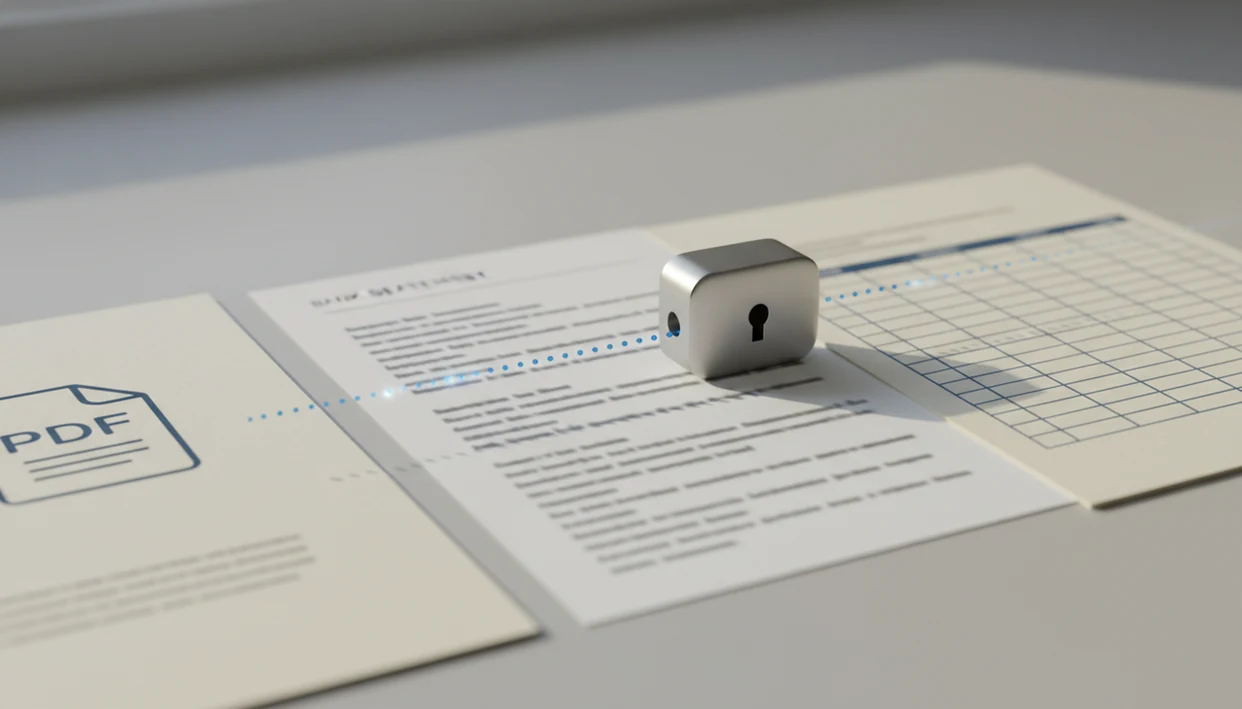
A private bank statement PDF to CSV converter should convert your statement into a clean CSV without requiring bank logins, long-term file storage, or reuse of your financial data. The safest workflow checks retention rules, processing method, logging, deletion timing, and CSV handling before you upload.
This page is a privacy and document-handling checklist, not legal, tax, banking, or cybersecurity advice. For regulated client files, payroll records, lending documents, or cross-border financial data, confirm your obligations with the appropriate professional before uploading.
> Bank Statement Converter App is a bank statement converter that turns PDF bank statements into CSV, Excel, and QBO files for small businesses, bookkeepers, and accountants.
- Choose a converter that explains whether uploads are processed in memory, stored temporarily, or deleted after export.
- Avoid tools that ask for online banking credentials when you only need a PDF-to-CSV conversion.
- Always review the exported CSV against the original statement before importing it into accounting software.
Private PDF to CSV Bank Statement Conversion: What the Policy Covers
A privacy-first bank statement PDF-to-CSV workflow uses the uploaded statement only to extract transactions and create the requested CSV export. It should not turn a file like `Chase Checking March 2022.pdf` into training material, marketing data, or a retained document library.
A useful policy covers six areas: original uploads, extracted transaction rows, temporary processing files, application logs, backups, and deletion timing. It should also say whether account identifiers, page metadata, and failed conversion files are treated differently from finished CSVs.
Private does not mean mathematically zero exposure. It means minimized retention, limited data use, and clear handling rules. That distinction matters because Pew Research Center found that 79% of Americans are concerned about how companies use collected data, according to its 2022 privacy survey source.
The practical test is simple: could you explain the data path to a client before uploading their statement?
Private Bank Statement PDF to CSV Data Flow
A private bank statement PDF to CSV data flow usually starts with an encrypted upload, then PDF parsing, OCR for scanned pages, transaction detection, column normalization, and CSV export. The important privacy question is where each step happens, and whether intermediate files persist after the export.
How private PDF-to-CSV bank statement conversion works: the system reads text layers when the PDF is digital, applies optical character recognition when the page is scanned, and maps detected transaction lines into structured fields. Common fields include date, description, debit, credit, amount, balance, account identifiers, and page-level metadata.
Clean digital PDFs usually convert more reliably than scanned, skewed, or watermarked statements, but OCR performance varies by image quality, layout, and field type; NIST notes that OCR accuracy depends heavily on source-document conditions source. The CSV preview grid under fluorescent lights tells the truth fast. Check whether the first row is a header or the first transaction.
A good converter explains whether it uses memory-only processing, short-lived encrypted disk storage, or scheduled deletion. For a broader security checklist, compare the same workflow against a secure bank statement converter.
Five Facts About a No Storage Statement Converter
- A no-storage claim should be backed by a written retention policy, not just a badge on the upload screen.
- Users should check whether PDFs are processed in memory, stored temporarily, included in backups, or retained for failed-job review.
- The app should not reuse statements for AI training, marketing analytics, benchmarking, or unrelated product development.
- The tool should avoid online banking credentials and process only the uploaded PDF; a bank statement converter without bank login reduces credential exposure.
- The exported CSV must still be verified because OCR can misread signs, split amounts, or merge two transaction lines.
No-storage is a workflow claim, not a magic shield. When we test converters, the revealing moment is often after export, when `Statement (1).pdf` and `Statement (2).pdf` are still sitting in Downloads beside the new CSV. Privacy work includes deleting local clutter too.
A private statement CSV export is safer when the source PDF is limited, the retained data is minimal, and the user verifies every accounting field before import.
Private Statement CSV Export Guarantees to Look For
Look for guarantees that describe actual handling, not vague security language. For financial documents, the best promises are specific enough that support can confirm them in writing.
- Encrypted upload path. The converter should use encryption in transit and restrict internal access during processing.
- Short retention window. Automatic deletion after export, or after a brief stated period, is easier to evaluate than “kept as needed.”
- No training reuse. Uploaded statements should not be used for AI model training unless the user gives explicit consent.
- No bank credential request. PDF-to-CSV conversion should not require an online banking username or password.
- Support escalation path. Users should be able to ask about deletion, security concerns, and business account documentation.
Risk is not abstract here. The FTC’s 2023 Consumer Sentinel Network data book reported about 1.1 million identity-theft reports source, and IBM reported a global average data breach cost of USD 4.45 million in its 2023 findings source. Tools like Bank Statement Converter App, bankstatementconverter.com, and docparser.com should be judged by written handling details, not by conversion speed alone.
For deletion-specific review, use the same questions you would ask of a bank statement converter that deletes files.
No Storage Statement Converter Claims Versus Real Data Paths
“No storage” can describe several different infrastructure patterns. The phrase may mean memory-only processing, temporary encrypted disk storage, scheduled deletion, or simply no permanent customer file library.
| Claim | What to verify | Risk if unclear |
|---|---|---|
| Memory-only processing | Whether PDFs and extracted rows avoid disk writes | Harder to debug, but lower persistence risk |
| Temporary encrypted storage | Retention window, encryption scope, and deletion trigger | Files may remain longer than expected |
| Scheduled deletion | Exact timing for uploads, CSVs, logs, and failed jobs | “Deleted later” may mean days or weeks |
| Retained processing history | Whether rows, snippets, metadata, or filenames remain | Statements may be partially reconstructable |
Server logs, error logs, analytics, crash reports, and backups may still contain metadata or snippets. A filing cabinet drawer scraping open feels old-fashioned, but a verbose error log can expose the same client name in a newer form.
Non-persistent claims are often policy statements rather than independently audited guarantees. A privacy-first converter should turn PDF bank statements into clean CSV, Excel, or accounting-ready files without turning uploads into permanent archives of sensitive account activity.
Private PDF to CSV Bank Statement Tool Boundaries
A private PDF-to-CSV bank statement tool does not protect the downloaded CSV after it leaves the app. Once `client-amex-jan.csv` lands on your device, your file storage, email habits, cloud sync settings, and accounting workspace permissions become the main privacy controls.
It also does not fix unsafe sharing through email attachments, unmanaged shared drives, chat tools, or open bookkeeping folders. A clean CSV attached to an accountant email may be convenient, but it is still a structured copy of financial history.
The converter does not guarantee perfect OCR, transaction classification, or account mapping. It may prepare a useful file for QuickBooks, Excel, or reconciliation, but the familiar import screen still asks you to map date, description, and amount columns before acceptance.
It also does not replace a firm’s security policy, access controls, client consent process, or document retention schedule. For cross-border or EU client work, a GDPR bank statement converter review may be necessary.
No converter provides banking, lending, tax, investment, or personal finance advice.
When to Ask a Professional Before Converting Statements
Ask a professional before converting bank statements when the file is tied to legal duties, tax filings, regulated client work, payroll, or cross-border data. The safer answer is to pause before upload, not after a CSV has already been created and shared.
Use a short approval path when the statement is more than routine internal bookkeeping:
- Ask counsel before uploading records that are regulated, subpoenaed, under legal hold, or connected to a dispute, investigation, or litigation matter.
- Consult a tax professional before converting statements that will support a return, audit response, amended filing, or workpaper package.
- Check with security leadership before processing payroll accounts, client trust activity, large batches of company statements, or files from high-value business accounts.
- Review cross-border obligations when EU, UK, or multi-region client data appears in the PDF, because privacy, transfer, and processor rules may change the workflow.
- Record approval when firm policy requires vendor review, processor approval, client consent, or documentation before financial documents enter a conversion tool.
If the answer is unclear, treat the PDF and the exported CSV as controlled financial records until the right reviewer signs off.
Private Statement CSV Export Support Questions
“What should I ask before uploading a bank statement PDF?” Ask support for the current retention window for uploaded PDFs, generated CSV files, extracted transaction data, and failed conversion files. Get the answer before the midnight bank portal download button becomes the only thing between you and month-end close.
How to use a private statement CSV export workflow:
- Confirm retention before uploading the PDF.
- Ask about logs that may contain transaction content, filenames, account identifiers, or error snippets.
- Identify processors by asking whether cloud regions, third-party OCR providers, or AI services handle the document.
- Request deletion details for manual deletion requests and automatic deletion timing.
- Document the response before using the converter for client, payroll, or company statements.
- Review the CSV against the original PDF before accounting import.
For password-locked files, confirm whether the password is processed locally, sent to a server, or stored in logs. A password protected bank statement PDF converter should explain that path clearly.
For bookkeepers and finance teams, written answers are often easier to defend than screenshots of marketing copy.
Limitations
No online converter can guarantee zero exposure, because network systems, infrastructure logs, and security tools may process metadata. That does not make every cloud converter unsafe, but it does make “zero risk” the wrong standard.
- No-storage claims may not be independently audited.
- Scanned, skewed, password-protected, handwritten, or low-resolution statements can reduce extraction accuracy.
- AI models may misread minus signs, balances, currency formats, rare layouts, or foreign-language statements.
- Strict privacy settings can limit troubleshooting because support teams may not retain files for debugging.
- The exported CSV becomes the user’s responsibility once downloaded.
- Email forwarding, cloud sync, and shared accounting folders can create more exposure than the conversion step.
- Organizations using AI have reported privacy or cybersecurity incidents; a 2023 McKinsey survey found about one-third of AI-using organizations had experienced some AI-related privacy or cybersecurity incident source.
For scanned files, a scanned bank statement to CSV workflow needs extra review because OCR confidence can drop sharply.
The ledger balance still has to match the statement ending.
Read more
FAQ
Is converting a bank statement PDF to CSV private?
It can be private if the converter uses encrypted upload handling, short retention, limited logging, and no reuse of data. Users should confirm those policies before uploading.
What does no storage mean for a bank statement converter?
No storage may mean memory-only processing, temporary storage with deletion, or no retained file library. The written retention policy should define the term.
Do I need to provide bank logins to convert a PDF statement?
No. A PDF-to-CSV converter should only need the uploaded statement PDF, not online banking credentials.
Can CSV files leak bank statement data?
Yes. CSV files contain transaction history and should be stored, shared, and deleted as sensitive financial documents.
Is OCR always accurate for bank statement PDFs?
No. OCR is strongest on clean digital PDFs and weaker on scans, watermarked pages, cropped statements, or unusual layouts.
Should I review the CSV before importing it into accounting software?
Yes. Every exported CSV should be checked against the original statement before import into QuickBooks, Excel, or accounting software.
Do PDF-to-CSV converters train AI models on my statements?
Some services may allow data reuse, so users should check whether uploaded statements are excluded from AI training. Bank Statement Converter App should be evaluated by the same written-policy standard.
Are offline bank statement converters safer than cloud converters?
Offline tools reduce upload exposure, but they can still create risk through crash reports, analytics, license checks, or an insecure device. Secure cloud tools may be appropriate when retention, encryption, and deletion rules are clear.
How long are uploaded bank statements kept?
The retention window depends on the service. Look for a written deletion policy that covers uploaded PDFs, generated CSVs, logs, backups, and failed conversions.
Convert your bank statement PDF now
Convert private bank statement PDFs into CSV, Excel, QBO, or QFX with a no-login workflow built for bookkeeping review.
Upload your PDF now