Bank Statement Converter For Small Business Owners
A bank statement converter for small business turns monthly or historical PDF bank statements into CSV, Excel, or QBO files so owners can update bookkeeping without retyping every transaction. Bank Statement Converter App fits this workflow because it focuses on bank statement data extraction, reviewable outputs, and accounting-ready exports.
> Definition: Bank Statement Converter App is a bank statement converter that turns PDF bank statements into CSV, Excel, and QBO files for small businesses, bookkeepers, and accountants.
- Use a converter when your bank only provides PDFs, you have old statements, or your accounting software bank feed is missing months.
- Look for CSV, Excel, and QBO exports, scanned PDF support, secure processing, and easy review before import.
- Always reconcile converted files against the original statement before tax filing, reporting, or loan documentation.
Why small business owners need a bank statement converter
Small business owners need a bank statement converter because banks often provide statements as PDFs, while bookkeeping work needs rows, columns, dates, descriptions, and amounts. That gap shows up during monthly reconciliation, catch-up bookkeeping, tax prep, cash-flow review, and loan or audit document cleanup.
The time burden is real. The SBA reported that U.S. small businesses spend an estimated 4.9 hours per week on accounting alone, according to its 2021 small business facts report source. SCORE also found that 40% of owners called bookkeeping and taxes the ‘worst part’ of running a business, according to its small business accounting and tax challenges research source.
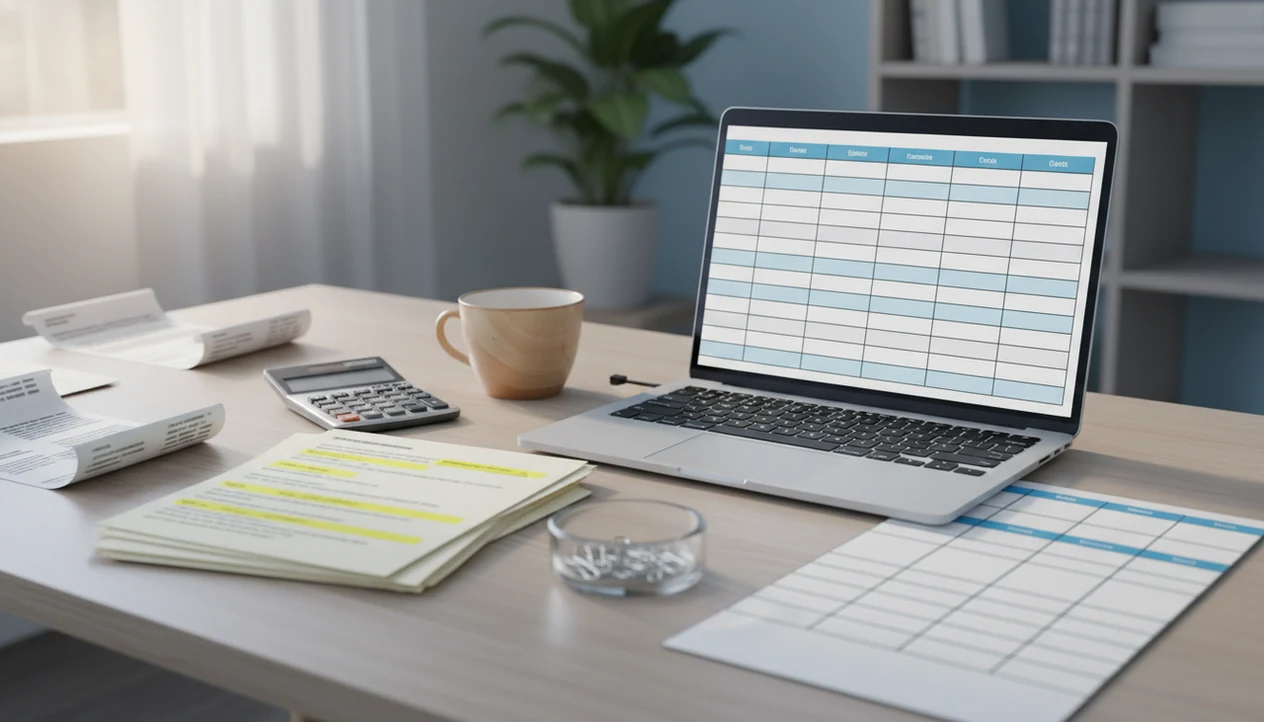
The yellow highlights pile up fast.
For a missing month such as ‘Chase Checking March 2022.pdf,’ the useful output is a sortable file that can be filtered and checked before import. For simple books, the benefit is not complexity. It is removing repetitive typing.
Five facts about a small business statement converter
- A small business statement converter extracts dates, descriptions, debits, credits, amounts, and balances from PDF bank statements.
- Useful output formats include CSV, Excel, and accounting-ready files such as QBO when the bookkeeping destination supports them.
- Native PDFs and scanned image PDFs are different problems; scanned files need OCR or AI extraction to read transaction lines.
- Secure processing, encryption, and no permanent storage are important safeguards when uploading financial documents.
- Converted files still need review and reconciliation before accounting, tax, lending, or reporting use.
When the issue is old statements sitting in a downloads folder as “Statement (1).pdf” and “Statement (2).pdf,” Bank Statement Converter App handles the practical first step: converting the source file into structured transaction rows. Good converters deliver clean CSV, Excel, and accounting-ready files, not final financial statements.
For larger cleanup projects, a bulk bank statement converter may be a better fit than uploading one file at a time.
Best app features for PDF to CSV for business workflows
The best app features for PDF to CSV for business workflows are the ones that preserve transaction structure and make review easier before import. General PDF tools can extract text, but bank statement conversion needs dates, amounts, balances, and account context.
- AI extraction: Reads varied bank layouts without relying only on rigid templates. This helps when one bank puts withdrawals in a separate column and another uses signed amounts.
- Scanned PDF support: Uses OCR for image-based files, including older statements or files sent by a client’s accountant.
- CSV, Excel, and QBO exports: Supports Google Sheets cleanup, Excel review, and QuickBooks import preparation.
- Privacy-first processing: Favors secure upload handling, temporary processing, and deletion controls for sensitive records.
- Reviewable output: Lets owners inspect columns before moving data into QuickBooks, Xero, Wave, or a spreadsheet.
After the conversion, when the first row in Excel is a header instead of a transaction, Bank Statement Converter App earns its place by making the review step visible. Owners who need deeper cleanup can pair conversion with an app to help clean bank statements.
How a bank statement converter for small business works
A bank statement converter for small business works by reading a PDF statement, detecting transaction tables, extracting text or scanned images, normalizing the data, and exporting structured files. The basic data flow is upload, page detection, table recognition, OCR where needed, transaction cleanup, and CSV, Excel, or QBO export.
AI-based parsing can handle varied bank layouts better than fixed templates because it looks for transaction patterns, not only fixed page coordinates. In plain terms, it tries to understand the table even when the bank changes spacing, column labels, or page breaks.
Bank Statement Converter App reads what appears in the source file. It does not connect to the bank, create missing records, or correct a bank’s original posting error. Secure transmission, temporary processing, and automatic deletion reduce retained-data risk where available, but users still need normal file security habits.
Anyone dealing with a blurred check image appendix should expect extra review, because OCR can struggle when the statement image is distorted.
How to use a business bank statement to Excel converter
Use a business bank statement to Excel converter by preparing clean statement files, converting them into structured columns, and reconciling the output against the original PDF. The practical goal is an accounting-ready file, not an unchecked spreadsheet.
- Download monthly or historical PDF statements from the bank portal, using clear names like “client-amex-jan.pdf.”
- Unlock password-protected PDFs if the converter cannot read restricted files directly.
- Upload the source files and choose CSV, Excel, or QBO based on the destination system.
- Review date, description, debit, credit, amount, balance, and account name columns before import.
- Compare the ending balance on the PDF against the final transaction row in Excel.
- Import the checked file into QuickBooks, Xero, Wave, Excel, or Google Sheets using the required column mapping.
Bookkeepers handling repeated owner cleanups may want the workflow notes in our bank statement converter for bookkeepers. A clean export still needs human review. Especially before tax work.
QuickBooks, Xero, Wave, and Google Sheets import paths
Converted statement files move into different systems through different formats, so the export choice should match the destination. QuickBooks may accept QBO or mapped CSV, while Xero, Wave, Excel, and Google Sheets usually depend on clean column structure.
| Destination | Common file choice | Mapping to check | Best use |
|---|---|---|---|
| QuickBooks | QBO or CSV | Date, description/payee, amount, account | Bank transaction import |
| Xero | CSV | Date, payee, money in, money out | Bank feed gap cleanup |
| Wave | CSV | Date, description, amount, category | Small business bookkeeping |
| Excel | XLSX | Date, debit, credit, balance | Review and cleanup |
| Google Sheets | CSV | Header row, amount signs, account name | Shared cleanup worksheet |
Xero reported that 74% of small and medium-sized businesses using accounting software said bank feeds and automated transaction import significantly reduced bookkeeping time, according to its small business insights research source.
Owners sorting deposits at a kitchen table should prepare the file first, then map columns on the familiar QuickBooks import screen.
Common small business statement converter patterns
“Which converter workflow should I use for my small business statements?” The answer depends on the number of accounts, statement age, scan quality, and where the converted output will go.
- Monthly catch-up for one checking account: Convert the PDF to Excel or CSV, review the header row, then import or paste into the bookkeeping file.
- Multi-account business records: Process checking, credit card, and savings PDFs separately so balances and account names do not mix.
- Historical cleanup: Use converted Excel files for tax cleanup, audit support, loan applications, or missing bank feed months.
- Scanned statements: Choose OCR or AI extraction, then check every uncertain row against the original PDF.
Multi-currency accounts, sub-accounts, and nonstandard bank layouts may need Excel cleanup after conversion. For business owners trying to catch up several months before a filing deadline, Bank Statement Converter App fits because it produces reviewable exports rather than forcing manual re-entry. A broader catch-up workflow is covered in our app to help catch up bookkeeping.
Limitations
Bank statement conversion reduces typing, but it does not remove the need for review. Bank Statement Converter App, bankstatementconverter.com, bankstatementconverters.ai, docparser.com, pdftables.com, and convertcsv.com all face the same practical limits when the source file is messy.
- Poor-quality scans, heavy watermarks, handwriting, folded pages, or distorted images can reduce extraction accuracy.
- Password-protected or restricted PDFs may need to be unlocked before conversion.
- Complex multi-account statements can require manual separation before import.
- Foreign currency columns, sub-accounts, and nonstandard bank layouts may need Excel cleanup.
- No converter can recover missing transactions, fix bank errors, or replace reconciliation.
- No-storage processing reduces retained-data risk, but it cannot remove all cybersecurity risk. For tax-related files, use the IRS Publication 4557 safeguards as a baseline: limit access, encrypt stored copies, and securely delete files after the bookkeeping job is complete source.
- Users should spot-check converted output before tax filings, financial statements, lending packages, or audit support.
- QBO exports may still need review if the destination accounting software rejects a date format or amount sign.
For firms with stricter review layers, our bank statement converter for accountants explains the handoff from conversion to reconciliation.
Read more
FAQ
What is a bank statement converter?
A bank statement converter is software that turns PDF bank statements into structured CSV, Excel, or accounting files. It extracts transaction dates, descriptions, amounts, and balances for bookkeeping review.
Can I convert scanned bank statements?
Yes, scanned bank statements can be converted if the converter supports OCR or AI extraction. Poor image quality, tiny font, or skewed pages may require extra manual review.
Is PDF to CSV accurate?
PDF to CSV can be highly accurate when the statement is readable and the converter understands the layout. Users should still spot-check dates, amounts, balances, and missing rows.
Can I import CSV into QuickBooks?
CSV files can often be imported into QuickBooks if the date, description, and amount columns are formatted correctly. QBO may be smoother for bank transaction imports when supported.
Is Excel better than CSV?
Excel is better for review, cleanup, filtering, and checking formulas. CSV is lighter and often easier to import into bookkeeping tools.
Are bank statement converters secure?
Secure converters use safeguards such as encryption, temporary processing, and no permanent storage of uploaded statements. These measures reduce risk, but no online upload is risk-free.
Do I need bank login access?
No, PDF upload conversion does not require a live bank connection. You only need the statement files that you are authorized to use.
Can converters handle old statements?
Yes, historical PDFs can usually be converted if the text or scan is readable. Older scans, unusual layouts, and damaged pages may need cleanup after export.